Why NGK Spark Plugs? Heat Range, Iridium & Fitment Guide for Malaysian Bikes
Why NGK dominates spark plug choice for Y15ZR, LC135, RS150 and other Malaysian bikes — heat range explained, iridium vs standard plugs, and a fitment chart for popular models.
MySpeedParts Team
· 5 min read
Why does everyone recommend NGK?
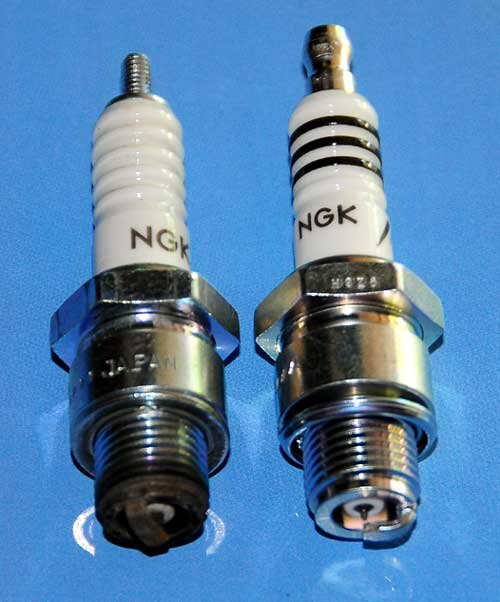
Walk into almost any bike shop in Malaysia and ask what spark plug to buy, and the answer defaults to NGK. That's not just brand loyalty — NGK Spark Plug Co., Ltd. (founded in Nagoya, Japan in 1936) is the original-equipment spark plug supplier for Honda, Yamaha, Suzuki and Kawasaki across most of their Southeast Asian lineup. When your bike left the factory, there's a very good chance it already had an NGK plug in it, which is why NGK's own part-number system doubles as the de-facto fitment reference for the entire underbone and kapchai scene — Y15ZR, LC135, RS150, Y16, Wave125, and EX5 included.
Photo: R69S — Wikimedia Commons (CC BY)
NGK isn't the only reputable brand — Denso (also Japanese, also a major OEM supplier) makes an equally solid plug — but because NGK's numbering is what most Malaysian tuners already reference on forums, Facebook groups and parts catalogues, it's the path of least confusion when you're cross-referencing a part number.
Heat range: the number that actually matters
A spark plug's heat range describes how quickly it moves heat away from the electrode tip into the cylinder head. It has nothing to do with how "hot" the spark itself is — every plug fires at roughly the same voltage. What changes is the plug's thermal behaviour under load:
- Too hot a plug (holds heat too long) → the tip stays hot enough after the spark to ignite the next fuel charge on its own, causing pre-ignition / detonation. This is what kills pistons in tuned engines.
- Too cold a plug (sheds heat too fast) → the tip never gets hot enough to burn off carbon deposits, so it fouls, misfires, and struggles to start when the engine is cold.
NGK denotes heat range with a number in the part code (e.g. CPR8EA-9, DPR6EA-9): a higher number in NGK's system means a colder plug (more heat rejection), while a lower number means hotter. Denso's scale runs the opposite direction, which is the single most common cause of a wrong cross-reference purchase — always check a proper cross-reference chart, never assume the numbers translate directly.
| Model (common variants) | Typical OEM NGK reference | Notes |
|---|---|---|
| Yamaha Y15ZR / Y16 | CPR8EA-9 (some markets: CPR9EA-9) | Fuel-injected; stick to OEM range unless tuned |
| Yamaha LC135 (carb/FI) | CPR7EA-9 / CPR8EA-9 | Varies by year/variant — check your service manual |
| Honda Wave125 / EX5 | CPR6EA-9 | Lower-revving engine, hotter range is normal |
| Suzuki RS150 | CR8E / CPR8EA-9 | Non-resistor CR8E on older carb models |
Always confirm against your bike's service manual or NGK's official cross-reference tool — engine tune, compression, and fuel type can shift the correct heat range even within the same model.
Standard nickel vs iridium vs platinum
The electrode material changes durability and spark consistency, not heat range:
- Standard nickel-alloy plugs (e.g. NGK's "E" series like CPR8EA) — the cheapest option, perfectly fine for stock engines, but the electrode erodes faster, so the gap widens over roughly 10,000–20,000 km and spark quality degrades gradually.
- Iridium plugs (NGK Iridium IX / Laser Iridium) — the centre electrode is a much finer iridium wire (as small as 0.4–0.6mm vs ~2.5mm on standard plugs), which needs less voltage to fire and resists erosion far better. NGK rates its Iridium IX line for roughly 2–4x the service life of standard plugs. The finer tip also improves flame kernel initiation, which can translate to marginally smoother idle and slightly better cold starting.
- Platinum plugs — sit in between on cost/durability, more common on cars than the small single-cylinder engines in this segment.
For a daily-ridden underbone, iridium is usually worth the price premium simply on service-interval math — you're replacing it a third as often. For a race engine that gets rebuilt or re-plugged every session anyway, the durability advantage matters less and a fresh standard plug per session is a perfectly reasonable choice.
Should you run a colder plug for a tuned engine?
If you've raised compression, run a bigger cam, added forced induction, or richened the exhaust/intake significantly, combustion chamber temperatures go up — and the stock heat range plug can start to run too hot, inviting pre-ignition. The common practice is to step one heat range colder than OEM (e.g. from CPR8EA-9 to CPR9EA-9) as tuning increases, and to re-check spark plug colour after a hard run: a light tan/grey electrode means the heat range and air-fuel mixture are in a healthy zone, while a white/blistered look signals it's running too hot or too lean.
For a bike that's still mostly stock, resist the urge to go colder "just in case" — an unnecessarily cold plug on a low-load engine will foul from carbon buildup, especially in stop-start city riding.
FAQ
Q: Can I use a Denso plug instead of the NGK-specified one? Yes, as long as you cross-reference correctly for both heat range and thread size/reach — Denso and NGK use opposite heat range numbering conventions, so don't just match numbers.
Q: How often should I replace my spark plug? Standard nickel plugs: roughly every 6,000–10,000 km for daily-ridden bikes. Iridium plugs: roughly 20,000–30,000 km, though always check for fouling/wear sooner if you notice rough idling or harder starting.
Q: Does a more expensive plug make more power? Not directly — heat range and correct gap matter far more for performance than electrode material. Iridium's real benefit is consistency over time and service life, not a raw power gain on an otherwise stock engine.
Q: What gap should I set my plug to? Always use the gap specified in your bike's service manual — pre-gapped plugs from the factory are usually correct out of the box, but it's worth checking with a gap gauge after transport, since gaps can shift slightly in the box.
References: NGK Spark Plugs — official heat range guide, NGK Iridium IX product information, Honda/Yamaha/Suzuki Malaysia service manuals for model-specific OEM plug references.
Frequently Asked Questions
Can I use a Denso plug instead of the NGK-specified one?+
Yes, as long as you cross-reference correctly for both heat range and thread size/reach — Denso and NGK use opposite heat range numbering conventions, so don't just match numbers.
How often should I replace my spark plug?+
Standard nickel plugs: roughly every 6,000–10,000 km for daily-ridden bikes. Iridium plugs: roughly 20,000–30,000 km, though check sooner if you notice rough idling or harder starting.
Does a more expensive plug make more power?+
Not directly — heat range and correct gap matter far more for performance than electrode material. Iridium's real benefit is consistency over time and service life, not a raw power gain on an otherwise stock engine.
What gap should I set my spark plug to?+
Always use the gap specified in your bike's service manual. Pre-gapped plugs are usually correct out of the box, but it's worth checking with a gap gauge, since gaps can shift slightly in transport.