What Is a "Jet Up" Crankshaft? Stroke, Displacement, and Malaysian Brand Options
"JET 4MM", "JET 8MM", "JET 10" — Malaysian racing crankshaft listings all use this naming, but what does the number mean, and what does jetting up actually change in the engine?
MySpeedParts Team
· 4 min read
What "jet up" means
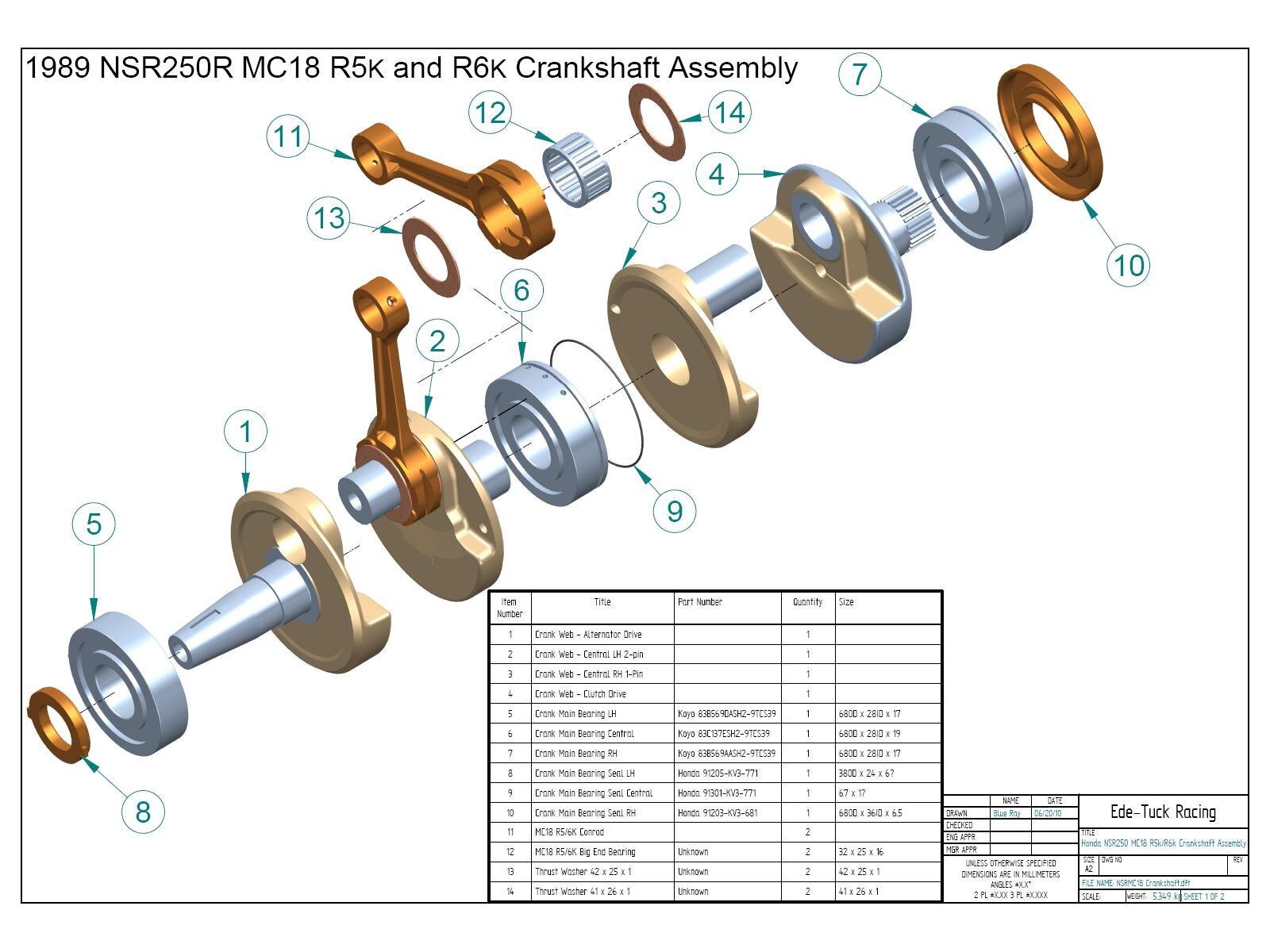
In Malaysian and regional underbone (kapchai) racing parts listings, a crankshaft advertised as "JET 4MM", "JET 6MM", "JET 8MM" or similar is a stroke-up crankshaft — the number is how many millimetres longer the stroke is compared to the engine's standard specification, achieved by moving the crank pin further from the crank centre. This is a completely different modification from boring the cylinder (which increases bore, not stroke), though the two are often combined in a full capacity-up build.
Photo: TuckerBag — Wikimedia Commons (public domain)
Why a longer stroke matters
Engine displacement is calculated from both bore and stroke — increasing either one raises swept volume. But stroke and bore affect the engine's character differently:
- Longer stroke = more torque per given bore, because the piston has a longer effective lever arm acting on the crank throw for the same combustion pressure. This is why stroke-up builds are popular for drag launches and low-to-mid RPM pulling power, which matters a lot in a 201m or quarter-mile standing-start race.
- Longer stroke = higher piston speed at the same RPM, since the piston now travels a longer distance per revolution. Mean piston speed is a real mechanical limit — beyond a certain speed, ring flutter, increased friction losses, and higher stress on the rod/crank become real risks. This is why a heavily jetted-up crankshaft usually comes with a lower safe redline than the standard part, not a higher one.
What else typically needs to change
A stroke-up crankshaft rarely bolts in as a completely standalone part:
- Piston — with the crank pin further out, the piston travels higher in the bore at TDC unless the piston itself (or the connecting rod length, or a machined case/cylinder base) compensates, or compression ratio and piston-to-valve clearance can go out of safe range.
- Cylinder/case clearance — some jet specs need minor case or cylinder base machining to physically clear the longer stroke.
- Carburetion/fuel injection tuning — a larger effective displacement changes the air-fuel requirement at a given throttle position, so jetting (carb) or ECU mapping (FI) typically needs revisiting.
This is why jet-up crankshafts are usually sold as part of a documented "complete set" (crank, rod, sometimes matched piston) rather than a bare crankshaft — the components are designed to work together for a specific jet spec.
Malaysian brand landscape
HPSP Racing is the most visible Malaysian-market brand offering a wide, clearly documented spread of JET-spec crankshafts — its Super Pro and Hyper King lines cover jet options from around 1mm up to 10mm across Y15ZR, LC135 (including 5-speed variants), RXZ, Wave125, and Y125 platforms, typically sold as complete crank-and-rod sets. Beyond HPSP, the wider Malaysian aftermarket also carries crankshafts from established regional performance brands that supply the broader Southeast Asian underbone racing scene — as with any performance part, cross-check the specific jet spec against your engine's other modifications (piston, head, cylinder) rather than assuming a bigger number is automatically the right choice for your build.
FAQ
Q: Does "JET 8MM" mean the bore is 8mm bigger? No — the jet number refers to stroke increase (crank pin offset), not bore. Bore changes come from boring/sleeving the cylinder, a separate modification often done alongside a stroke-up crank in a full capacity build.
Q: Is a bigger jet number always better for racing? Not automatically — a larger stroke increase raises piston speed at a given RPM and generally requires a lower safe redline, plus supporting parts (piston, sometimes case clearance work). The right jet spec depends on your intended use (drag launch torque vs sustained high-RPM top speed) and the rest of your build.
Q: Can I install a jet-up crankshaft without changing the piston? Usually no — most jet specs require a matched piston (and sometimes minor case/cylinder machining) to keep compression ratio and piston-to-valve/head clearance in a safe range, which is why jet cranks are typically sold as complete sets.
Q: Do I need to re-tune my carburettor or fuel injection after a jet-up crank? Yes — the increased displacement changes the air-fuel requirement, so carb jetting or ECU mapping typically needs adjustment to match the new effective displacement.
References: general two/four-stroke engine displacement and stroke-length engineering principles; HPSP Racing product listings for Malaysian-market JET-spec crankshaft options (Super Pro, Hyper King lines).
Frequently Asked Questions
Does JET 8MM mean the bore is 8mm bigger?+
No — the jet number refers to stroke increase (crank pin offset), not bore. Bore changes come from boring/sleeving the cylinder, a separate modification.
Is a bigger jet number always better for racing?+
Not automatically — a larger stroke increase raises piston speed at a given RPM and generally requires a lower safe redline, plus supporting parts. The right jet spec depends on your intended use and the rest of your build.
Can I install a jet-up crankshaft without changing the piston?+
Usually no — most jet specs require a matched piston to keep compression ratio and clearance in a safe range, which is why jet cranks are typically sold as complete sets.
Do I need to re-tune my carburettor or fuel injection after a jet-up crank?+
Yes — the increased displacement changes the air-fuel requirement, so jetting or ECU mapping typically needs adjustment.