Back Pressure vs Through-Flow (Straight-Through) Exhaust: Which Is Actually Best?
"No back pressure = more power" is only half true. Here's how back pressure and scavenging actually work in a small-capacity engine, and when a chambered exhaust beats a straight-through pipe.
MySpeedParts Team
· 5 min read
The myth: "no back pressure = more power"
It's one of the most repeated lines in any bike shop: "buka terus, takde back pressure, power naik." It's not entirely wrong — but it's incomplete, and taken too literally it causes people to bolt on a straight-through pipe expecting a free power gain, then wonder why their bike feels flat off idle.
To understand why, you need to separate two different things that both get lumped under "back pressure":
- Restriction — the flow resistance created by tight bends, small diameters, and dense packing (like a small muffler baffle or catalytic converter). Pure restriction is genuinely just a power loss — it fights the engine on every stroke.
- Scavenging — the useful pressure-wave effect where the shape and length of the exhaust system reflects a pulse of pressure back into the cylinder or expansion chamber at exactly the right moment in the cycle, either helping pull fresh mixture in (2-stroke) or helping clear residual exhaust gas out (4-stroke).
Scavenging isn't "back pressure" in the bad sense — it's precisely-timed pressure, which is a completely different thing from a pipe that's simply too small or too restrictive everywhere.
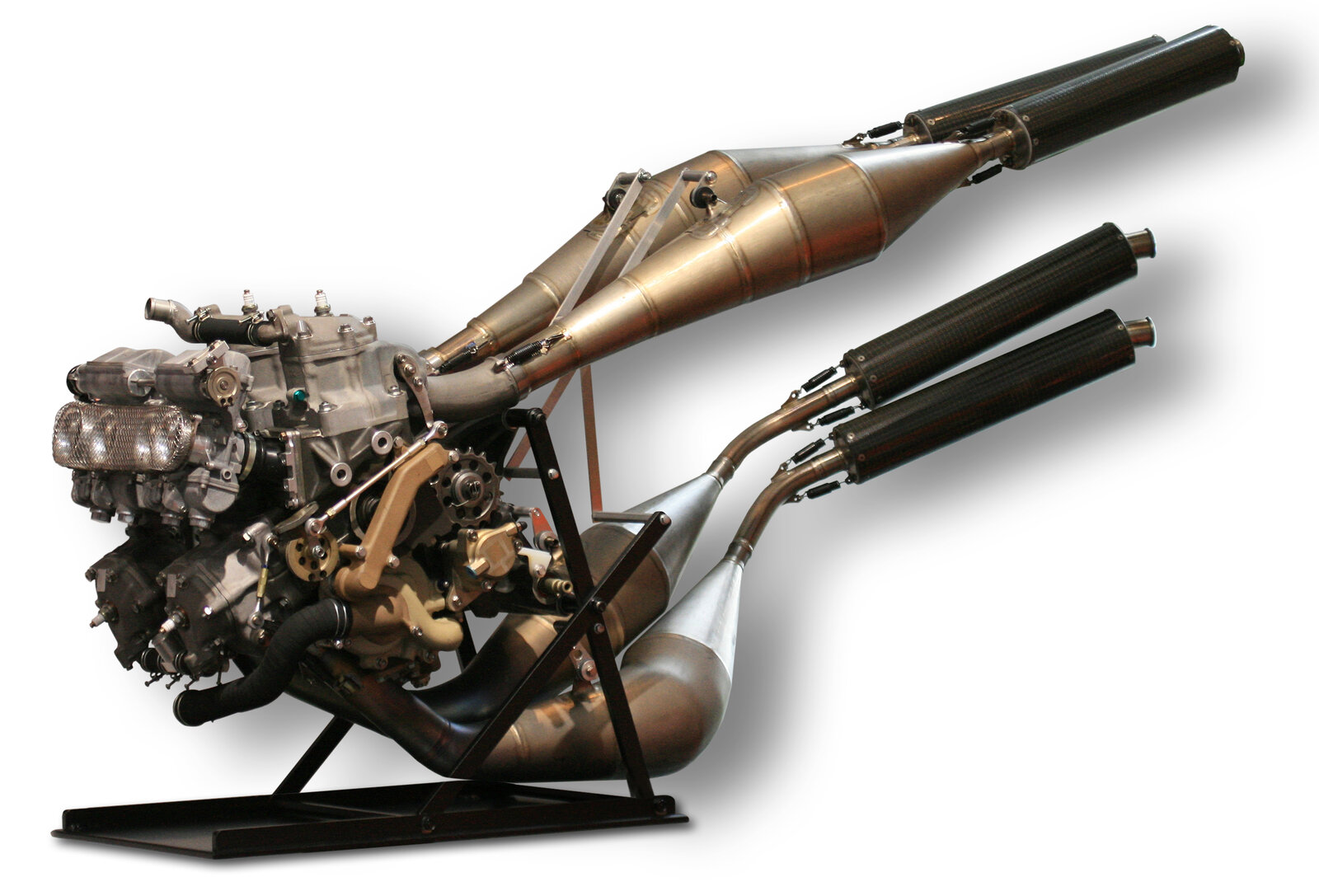
Photo: Morio — Wikimedia Commons (CC BY-SA 3.0)
How a chambered/expansion-chamber exhaust uses this
This effect is most dramatic on 2-stroke expansion chambers (classic on RXZ, LC135 2T-era engines, and race 2-strokes), where the diverging cone, belly, and converging "stinger" cone are shaped to send a negative pressure wave back toward the exhaust port during the scavenging phase (helping pull the fresh charge in), followed by a positive pressure wave right as the piston closes the port (pushing any escaping fresh charge back in before it's lost out the exhaust). Get the chamber dimensions right for a specific RPM and the engine gains a genuinely dramatic torque spike in that band — get it wrong and you can lose power everywhere else.
Four-stroke "chambered" or "cutting-open" street exhausts (like the HPSP-style chamber boxes popular on Y15ZR/LC135) use a milder version of the same principle: an internal chamber and baffle arrangement tuned to help extract exhaust gas efficiently across a usable RPM range, rather than one narrow peak. This is why a well-designed chambered exhaust can genuinely out-perform a cheap straight-through pipe in the low-to-mid range, even though the straight-through pipe flows more total volume.
What a straight-through (through-flow/free-flow) pipe actually does
A straight-through pipe — minimal internal baffling, closer to a straight tube with perforated core and packing — reduces flow restriction and lets the engine breathe more freely at high RPM, where cylinder-filling time is short and every bit of reduced backpressure helps. This is why race exhausts on high-revving four-stroke engines (superbikes, and tuned four-stroke underbones built for top-end) trend toward straight-through designs paired with a matched cam, bigger valves/ports, and remapped fuel/ignition.
The trade-off: without a chamber shaping useful reflected pulses, a straight-through pipe on an otherwise-stock, low-compression, mild-cam engine typically loses torque in the low-to-mid RPM range compared to a well-tuned chambered exhaust, because there's nothing helping scavenge the cylinder efficiently at those lower engine speeds. This is the classic "sounds loud, feels the same or slower off the line" complaint.
Side-by-side
| Chambered / back-pressure-tuned | Straight-through / free-flow | |
|---|---|---|
| Best RPM range | Low-to-mid range torque | High-RPM top-end power |
| Street rideability | Generally better throttle response, less flat spots | Can feel flat/laggy low down if not tuned as a package |
| Best paired with | Mostly-stock to mildly tuned engines | Cam, compression, and jetting/mapping changes to match |
| Typical use case | Daily street riding, drag launches, stoplight-to-stoplight | Track/race builds tuned around top-end |
| Risk if mismatched | Can restrict top-end revs if chamber is too small | Can lose low-end torque and throttle response |
So which one should you pick?
- Riding mostly stock or mildly tuned, mostly on the street → a well-designed chambered exhaust almost always feels better in real-world riding, because most street riding happens in the low-to-mid RPM range where scavenging tuning helps most.
- Building a dedicated high-RPM race engine with matching cam/compression/fuelling changes → a straight-through system lets the rest of the tuned package actually use the RPM range it's built for, and the reduced backpressure stops the exhaust from being the bottleneck.
- Just bolted on a loud pipe for sound with no other changes → this is where most people get burned, since a straight-through pipe with no other supporting mods commonly gives you less usable power in daily riding despite being louder.
The honest engineering answer is that neither option is universally "best" — the exhaust has to match the rest of the engine's tune and the RPM range you actually ride in.
FAQ
Q: Does removing back pressure always increase horsepower? Only peak horsepower at high RPM, and only if the rest of the engine (cam, compression, fuelling) is tuned to use that higher RPM range. On a stock or mild engine it typically reduces usable low-to-mid range torque.
Q: Why do 2-stroke expansion chambers look like that weird shape? The diverging cone, belly, and converging stinger are precisely shaped to generate timed pressure waves that assist scavenging at a specific RPM — this is called "tuned pipe" theory, and the dimensions are calculated around the engine's port timing and target RPM.
Q: Is a louder exhaust always a faster exhaust? No. Loudness comes from reduced sound-deadening material and open flow paths, which is unrelated to whether the pipe is actually tuned to help or hurt your engine's powerband.
Q: Can I get "the best of both"? Some modern designs use a chambered section followed by a straight-through style outlet to blend low-end scavenging with reduced high-RPM restriction, but true dual-range performance usually needs the rest of the engine tuned to match.
References: two-stroke expansion chamber (tuned pipe) theory as described in Gordon Jennings' "Two-Stroke Tuner's Handbook"; general exhaust scavenging principles from SAE technical literature on four-stroke exhaust system design.
Frequently Asked Questions
Does removing back pressure always increase horsepower?+
Only peak horsepower at high RPM, and only if the rest of the engine (cam, compression, fuelling) is tuned to use that higher RPM range. On a stock or mild engine it typically reduces usable low-to-mid range torque.
Why do 2-stroke expansion chambers look like that weird shape?+
The diverging cone, belly, and converging stinger are precisely shaped to generate timed pressure waves that assist scavenging at a specific RPM — this is 'tuned pipe' theory, calculated around the engine's port timing and target RPM.
Is a louder exhaust always a faster exhaust?+
No. Loudness comes from reduced sound-deadening material and open flow paths, which is unrelated to whether the pipe is actually tuned to help or hurt your engine's powerband.
Can I get the best of both worlds?+
Some modern designs blend a chambered section with a straight-through style outlet, but true dual-range performance usually needs the rest of the engine tuned to match.