DIY Exhaust Tutorial: How to Calculate Exhaust Pipe Specs for Modification Without a Dyno
No dyno? No problem. A practical, formula-based method to size header pipe diameter and length for your engine build, plus how to verify your calculations on the road using plug reads and EGT.
MySpeedParts Team
· 5 min read
Why calculate before you cut pipe
A lot of exhaust modifications are done by eye — a pipe size gets picked because "it looks right" or because another shop used that size. The problem is that header pipe diameter and length have a large effect on where your engine's powerband actually sits. Get it wrong and your engine can end up trading away low-end torque for top-end power you'll never actually use in daily riding — or the other way around.
The good news: you don't need a dyno to get a reasonable estimate. The same basic engineering formulas engine builders worldwide have used for decades can get you within 80–90% of the right spec. The remaining 10–20% gets refined through plug reads, EGT, and a road test.
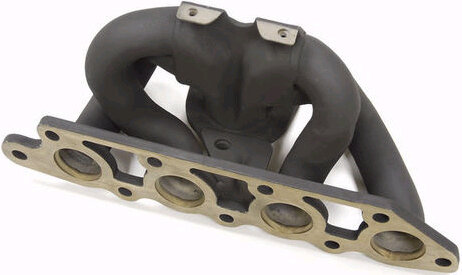
Photo: Zircotec — Wikimedia Commons (CC BY)
Step 1: Calculate primary (header) pipe diameter
The standard formula widely used by engine builders (originally popularised for V8s, but scales linearly down to small single/multi-cylinder engines) is:
Pipe diameter (inches) = √[(CID × RPM) ÷ (Number of cylinders × 88,200)]
Where:
- CID = engine displacement in cubic inches (1 cc = 0.061 CID; e.g. a 150cc engine = 9.15 CID)
- RPM = your target peak-power RPM (not redline — the RPM where you actually want maximum torque/power)
- Number of cylinders = engine cylinder count
Example: 150cc single-cylinder engine, target peak power at 9,000 RPM
- CID = 150 × 0.061 = 9.15
- Diameter = √[(9.15 × 9,000) ÷ (1 × 88,200)] = √[82,350 ÷ 88,200] = √0.933 = 0.966 in ≈ 24.5mm inner diameter
So for a 150cc engine tuned for peak power around 9,000 RPM, a header pipe with roughly 24–25mm inner diameter is a reasonable estimate. Push the target RPM higher (a more highly-tuned engine) and the calculated diameter increases slightly too, since a higher-revving engine needs more flow area to avoid becoming a bottleneck.
Note: this formula gives a good starting estimate for four-strokes. For two-stroke expansion chambers, dimensions are calculated differently based on port timing and tuned-pipe theory — see a resource like Gordon Jennings' "Two-Stroke Tuner's Handbook" for the two-stroke-specific formulas.
Step 2: Calculate primary pipe length
The optimum primary pipe length is closely tied to your target RPM through exhaust pulse-tuning theory — essentially, you want the negative pressure wave reflected back from the end of the pipe to arrive back at the exhaust valve exactly during valve overlap, to help scavenging.
A commonly used estimation formula (for a four-stroke single primary pipe before it joins a collector):
Pipe length (inches) ≈ (850 × (360 − Exhaust Valve Opening Angle)) ÷ RPM
Where "Exhaust Valve Opening Angle" refers to the camshaft angle (degrees after TDC) at which the exhaust valve opens — this value comes from your cam's spec sheet (stock cams vs racing/performance cams have different angles; check your cam supplier's spec sheet).
For most stock/mild-performance cams on an underbone engine, this angle typically sits around 70–90°. Using an estimate of 80° and a target of 9,000 RPM as an example:
- Length = (850 × (360 − 80)) ÷ 9,000 = (850 × 280) ÷ 9,000 = 238,000 ÷ 9,000 ≈ 26.4 inches (roughly 67cm)
This is a starting estimate, not an absolute figure — the actual optimum length is also influenced by pipe diameter, collector design, and overall system backpressure.
Step 3: Verify it without a dyno
Once the pipe is built and installed, three practical methods let you check how close your estimate landed:
- Spark plug colour read — after a hard pull (a few seconds of full throttle), cut the engine immediately without letting it idle down, then pull the plug and check the electrode. Light tan/brown = healthy mixture and tune. White/pale = running too lean (the header may be too large/short for the target RPM, or you need to re-jet). Black and sooty = running too rich.
- Exhaust Gas Temperature (EGT) — use a cheap EGT gauge or an infrared thermometer on the header near the port. A stable, consistent EGT at your target RPM (versus wild swings) indicates efficient exhaust flow with no "holes" in scavenging.
- Roll-on/roll-off test — compare acceleration time in a fixed gear (e.g. 40km/h to 80km/h) before and after installation, under the same road and load conditions. This isn't precise scientific data, but it's a reliable comparison if you control other variables (tyres, load, weather).
If the test shows the engine feels "flat" at a particular RPM versus what you expected, it usually means the pipe length or diameter needs a small adjustment (cut shorter to shift the powerband up, add length to shift it down) — this trial-and-refine step is still needed even with a real dyno.
Safety note
All the calculations above are general engineering estimates, not a guarantee of an exact result for every engine. Always test gradually (not full throttle immediately after fitting a new pipe), monitor engine temperature, and stop immediately if you hear unusual knocking/detonation — a sign the mixture is too lean or the ignition timing doesn't suit the new exhaust system.
FAQ
Q: Are these formulas 100% accurate without a dyno? No — they're proven engineering estimates that make a good starting point (typically within 80–90% of the optimal spec). Final fine-tuning (jetting, ignition timing) still needs plug reads and a road test.
Q: Why does target RPM matter so much in the calculation? Because the entire point of exhaust tuning is matching the pressure wave to the valve cycle AT a specific RPM — choose your target RPM based on where you actually want the engine to be strongest (e.g. mid-range for daily riding, high RPM for track racing).
Q: Can I use the same formula for a two-stroke engine? Not directly — two-stroke expansion chambers use different tuned-pipe theory based on port timing rather than camshaft angles. Refer to two-stroke-specific resources like Gordon Jennings' book.
Q: What if I don't have an EGT gauge? A plug read alone (done correctly — cutting the engine immediately after full throttle, not letting it idle first) still gives useful information about the air-fuel mixture, even if it's less precise than continuous EGT monitoring.
References: header sizing and pulse-tuning formulas are standard engine engineering theory widely used in performance engine building (referenced across various engine-building manuals and automotive engineering resources); "Two-Stroke Tuner's Handbook" by Gordon Jennings for two-stroke-specific theory.
Frequently Asked Questions
Are these formulas 100% accurate without a dyno?+
No — they're proven engineering estimates that make a good starting point (typically within 80–90% of the optimal spec). Final fine-tuning still needs plug reads and a road test.
Why does target RPM matter so much in the calculation?+
Because the entire point of exhaust tuning is matching the pressure wave to the valve cycle AT a specific RPM — choose your target RPM based on where you actually want the engine to be strongest.
Can I use the same formula for a two-stroke engine?+
Not directly — two-stroke expansion chambers use different tuned-pipe theory based on port timing rather than camshaft angles.
What if I don't have an EGT gauge?+
A plug read alone still gives useful information about the air-fuel mixture, even if it's less precise than continuous EGT monitoring.