Engine Cylinder Count Explained: Single, Twin, Triple, Four — Is More Always Better?
Single-cylinder Y15ZR, parallel-twin R25, four-cylinder CBR250RR... does cylinder count actually mean a better bike? Here's what changes with more cylinders, and why more isn't automatically best.
MySpeedParts Team
· 5 min read
What actually changes when you add cylinders
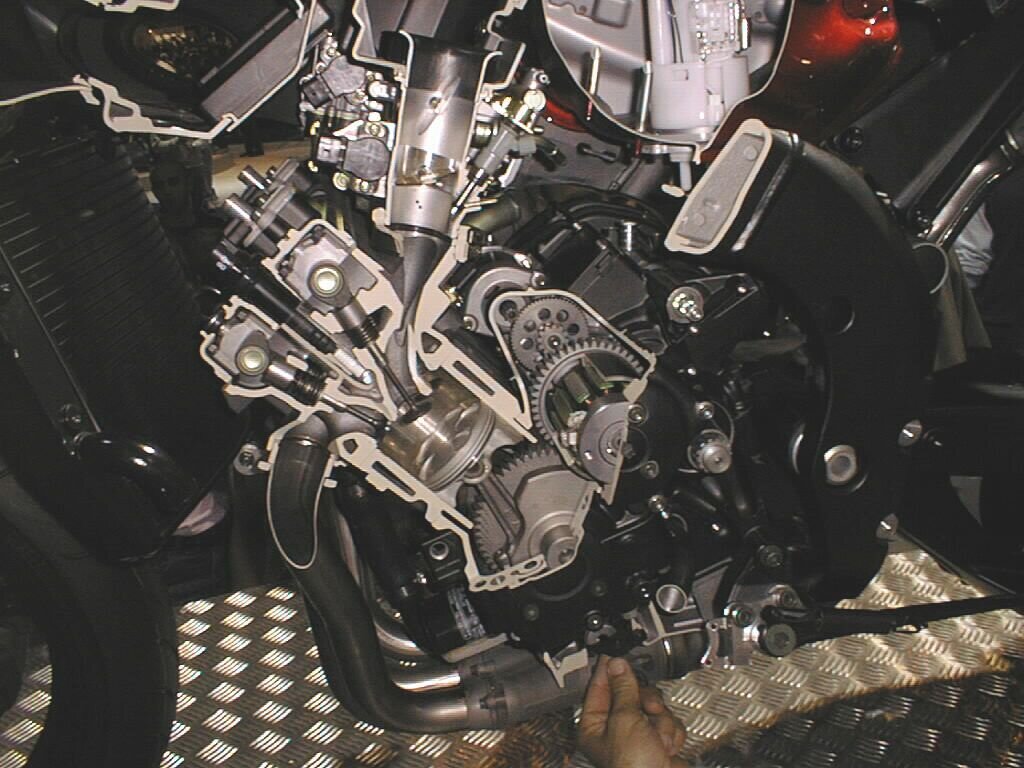
Cylinder count affects four things directly: vibration and smoothness, achievable redline, power character (low-end torque vs top-end rush), and weight/cost/complexity. It's tempting to treat “more cylinders” as a straightforward upgrade — but engine design doesn't work that way. Each additional cylinder is a genuine trade-off, not a free upgrade.
Photo: Cjp24 — Wikimedia Commons (CC BY-SA 3.0)
Single-cylinder: the underbone default (Y15ZR, RS150, LC135)
A single-cylinder engine has one piston firing once every two crankshaft revolutions (in a 4-stroke). This is mechanically the simplest possible configuration.
Pros: lightest weight for a given displacement, cheapest to manufacture and maintain (fewer parts means fewer things to service or fail), strong low-RPM torque per cc since the entire displacement fires in one combustion event, and a narrow engine profile that suits small, light underbone chassis.
Cons: inherently more vibration (one large combustion pulse per cycle, needing balance shafts or careful crank counterweighting to tame), and a practically lower redline ceiling since a single large piston has more reciprocating mass to accelerate and decelerate at high RPM.
This is exactly why the entire underbone/kapchai segment (Y15ZR, RS150, Y16, most of the LC135 line) runs single-cylinder engines — for this class of light, affordable, easy-to-maintain commuter-turned-performance bike, a single-cylinder's advantages line up almost perfectly with what the segment needs.
Parallel-twin: the smoother, higher-revving step up (R25, Ninja 250 twin generations, Z250)
Two cylinders sharing the work means each individual combustion event handles roughly half the total displacement, which directly reduces the reciprocating-mass problem — the engine can rev higher before hitting the same vibration/stress limits a single would hit sooner. Depending on crank configuration (180°, 270°, or 360°), a parallel-twin can also achieve meaningfully smoother running than a single, while staying reasonably compact, light, and affordable to manufacture compared to four cylinders.
This is why 250cc-class sport bikes commonly use parallel-twins — they need a higher, sportier redline than an underbone single while staying light and reasonably priced.
Inline-four: maximum smoothness and top-end, at a cost (CBR250RR, larger literbikes)
Adding a third and fourth cylinder further subdivides the displacement per combustion event, which is why inline-four sport bikes (Honda's CBR250RR being the best-known small-capacity example) and larger four-cylinder superbikes can safely rev to 12,000–14,000+ RPM with dramatically smoother delivery than a single or twin of equivalent displacement could manage.
The trade-offs scale directly with cylinder count: more pistons, valves, camshaft lobes, and ignition events mean more parts (higher manufacturing cost), more internal friction (a four-cylinder has to overcome more moving-part friction than a single of the same total displacement, costing a small amount of low-RPM efficiency), more weight (more metal, more supporting components), and a wider engine block that changes chassis packaging.
Side-by-side
| Single (Y15ZR, RS150) | Parallel-twin (R25, Ninja 250 twin) | Inline-four (CBR250RR) | |
|---|---|---|---|
| Vibration | Highest, usually needs a balancer shaft | Moderate, depends on crank configuration | Lowest, very smooth |
| Practical redline | Lower, roughly 10,000–11,000 RPM class | Higher, roughly 12,000 RPM class | Highest, roughly 14,000+ RPM class |
| Low-RPM torque per cc | Strong, whole displacement fires at once | Moderate | Lower per cylinder, needs RPM to make power |
| Weight and cost | Lightest, cheapest | Moderate | Heaviest, most expensive |
| Typical use case | Light commuter/performance underbones | Mid-capacity sport bikes wanting a sportier redline | Small-capacity bikes chasing maximum smoothness and top-end |
So is more cylinders always better?
No — and the reason is straightforward once you separate what each configuration is actually optimising for:
- If the goal is a light, cheap, easy-to-maintain daily bike with strong low-end torque (which describes most of what underbone/kapchai riders actually want), a single-cylinder is arguably the better engineering choice, not a compromise. This is why manufacturers haven't rushed to put twins or fours into the Y15ZR/RS150 class even though the technology exists.
- If the goal is a higher redline, smoother high-RPM power delivery, and a more “premium” feel, more cylinders genuinely deliver that — at the cost of weight, complexity, and maintenance cost (more valves to adjust, more spark plugs to replace, generally higher parts cost).
- Displacement-for-displacement, more cylinders rarely means more peak power on a stock, naturally-aspirated engine — total displacement, compression ratio, valve/port design, and tuning matter far more than cylinder count alone. A well-tuned single can out-torque a poorly-tuned twin of the same displacement.
The honest engineering answer: cylinder count is a design tool for shaping how an engine delivers its power (vibration, redline, character), not a simple “more equals better” dial.
FAQ
Q: Does a 4-cylinder engine always make more horsepower than a single of the same capacity? Not automatically — peak horsepower depends heavily on tuning, compression, and valve/port design. What a four-cylinder reliably offers is a higher achievable redline and smoother delivery, which often (but not always) translates to more peak power because it can safely rev further.
Q: Why do underbone bikes stick with single-cylinder engines instead of upgrading to twins? Because a single-cylinder's strengths — light weight, low cost, simple maintenance, strong low-end torque — line up almost exactly with what a light, affordable commuter/performance underbone needs. Adding cylinders would raise cost and weight for benefits (smoothness, higher redline) that matter less in this use case.
Q: Is engine vibration always bad? Not entirely — some riders and brands treat a certain amount of single-cylinder "character" and torque pulse as a desirable feel, similar to how some car enthusiasts prefer the character of a V8 over a smoother but more clinical engine. It becomes a genuine downside mainly at sustained high RPM or long-distance comfort.
Q: Does more cylinders mean more maintenance cost? Generally yes — more spark plugs, more valves needing periodic clearance adjustment, more parts that can wear, and typically higher-cost parts overall compared to an equivalent-displacement single.
References: general internal combustion engine configuration principles as documented in standard automotive/motorcycle engineering references and manufacturer technical specifications for the models named above.
Frequently Asked Questions
Does a 4-cylinder engine always make more horsepower than a single of the same capacity?+
Not automatically — peak horsepower depends heavily on tuning, compression, and valve/port design. A four-cylinder reliably offers a higher achievable redline and smoother delivery, which often translates to more peak power because it can safely rev further.
Why do underbone bikes stick with single-cylinder engines instead of upgrading to twins?+
Because a single-cylinder's strengths — light weight, low cost, simple maintenance, strong low-end torque — line up almost exactly with what a light, affordable commuter/performance underbone needs.
Is engine vibration always bad?+
Not entirely — some riders treat a certain amount of single-cylinder character and torque pulse as a desirable feel. It becomes a genuine downside mainly at sustained high RPM or long-distance comfort.
Does more cylinders mean more maintenance cost?+
Generally yes — more spark plugs, more valves needing periodic clearance adjustment, more parts that can wear, and typically higher-cost parts overall compared to an equivalent-displacement single.